

Table of Contents
Introduction: Why the Marketing Funnel Changes Everything
Imagine you open a small shop. Hundreds of people walk past every day. But only a handful actually walk in. And out of those, maybe one or two buy something. That gap between “walking past” and “buying” is exactly what a marketing funnel helps you understand and fix.
If you have ever wondered why people visit your website but never buy, or why your ads seem to get clicks but no sales, the marketing funnel is your answer. It maps out the full customer journey, from the moment someone first hears about you to the moment they become a loyal customer.
In this guide, you will learn what a marketing funnel is, how each stage works, and how to build one for your own business, even if you are starting from zero.

What Is a Marketing Funnel, Really?
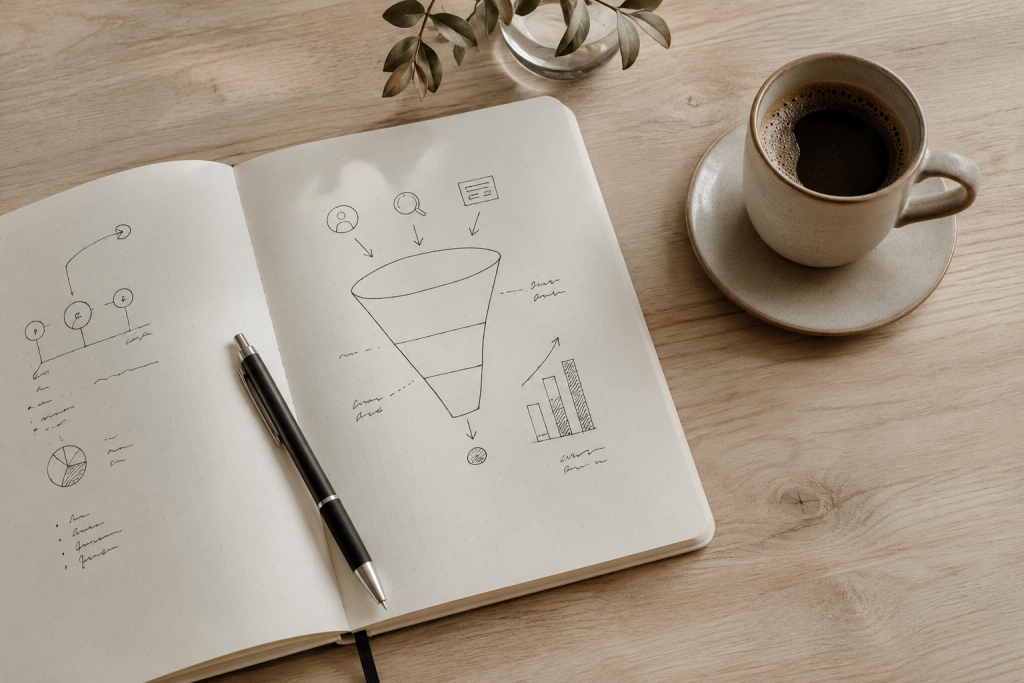
A marketing funnel is a model that shows how potential customers move through different stages before making a purchase. Think of it like a real funnel. You pour a lot of people in at the top. By the time they reach the bottom, a smaller but more committed group has decided to buy.
The concept behind a marketing funnel is simple. Not everyone who hears about your business is ready to buy right away. Some people are just curious. Others are comparing options. A few are ready to pull out their credit card. The funnel helps you speak to each group in the right way, at the right time.
According to HubSpot, businesses that map out their customer journey and align content with each stage see significantly better conversion rates than those who do not.
The marketing funnel is not just a sales tool. It is the backbone of your entire digital marketing strategy.

The 7 Smart Stages of a Marketing Funnel
This is the core of your marketing funnel. Each stage represents a different mindset your customer is in. Your job is to guide them gently from one stage to the next.
Stage 1: Awareness
This is the very top of the funnel. At this stage, your potential customer does not even know you exist yet. Lead generation starts here. You attract people through blog posts, social media, ads, videos, or word of mouth.
Your goal here is simple: get noticed. The wider your reach, the more people enter your marketing funnel.
Stage 2: Interest
Now the person knows you exist and wants to learn more. They follow your social page, read your blog, or sign up for your newsletter. At this stage, you should provide useful, engaging content that keeps them coming back.
Think about what questions your audience is asking. Then answer those questions better than anyone else.
Stage 3: Consideration
Here, your potential customer is actively thinking about whether your product or service could solve their problem. They compare you with competitors. They read reviews. They check your pricing page.
This is where strong content like case studies, testimonials, and comparison guides can make a big difference to your conversion rate.
Stage 4: Intent
At this stage, the customer has shown a clear sign of wanting to buy. They might add something to their cart, request a demo, or fill out a contact form. This is a critical moment in the customer journey.
Your follow-up game needs to be strong here. A well-timed email or a retargeting ad can bring them back to complete the purchase.
Stage 5: Evaluation
The customer is almost ready, but they are making one final check. They want to feel confident. This is where you remove any last doubt. Offer a free trial, a money-back guarantee, or detailed FAQs.
Trust is the currency of this stage.
Stage 6: Decision
This is the bottom of the funnel. The customer has decided to buy. Your job now is to make the purchase process as smooth and simple as possible. A complicated checkout process or slow website can lose the sale right at the finish line.
A good digital marketing strategy makes the decision stage frictionless.
Stage 7: Retention
Many people forget this stage, but it is just as important as all the others. A customer who buys once is good. A customer who buys again and again is gold.
Use email marketing, loyalty programs, and personalised follow-ups to keep your customers happy and coming back.
Marketing Funnel vs Sales Funnel: What Is the Difference?
A lot of beginners use these two terms interchangeably. They are related, but not the same thing.
| Feature | Marketing Funnel | Sales Funnel |
|---|---|---|
| Focus | Awareness to loyalty | Interest to purchase |
| Owned by | Marketing team | Sales team |
| Goal | Build relationship and trust | Close the deal |
| Stage range | Full customer journey | Bottom of funnel only |
| Key tool | Content, ads, email | CRM, calls, demos |
| Metrics | Traffic, leads, engagement | Conversions, revenue |
| Time frame | Long-term brand building | Short-term conversion |
As you can see from the table, the marketing funnel covers a broader range of the customer journey. The sales funnel is focused specifically on converting warm leads into paying customers. Both work together as part of your overall digital marketing strategy.
Pros and Cons of Using a Marketing Funnel
Pros of a Marketing Funnel
- Gives you a clear picture of your customer journey from start to finish
- Helps you identify exactly where you are losing potential customers
- Improves your conversion rate by delivering the right message at the right time
- Makes your lead generation efforts more targeted and efficient
- Builds stronger, longer-lasting relationships with your audience
- Gives your entire team a shared framework to work from
Cons of a Marketing Funnel
- Can take time and consistent effort to build properly from scratch
- Requires regular testing and adjustments as customer behaviour changes
- Some businesses apply it too rigidly, forgetting that real people are not always linear
- Measuring results accurately requires the right tracking tools in place
- If set up poorly, it can lead to generic messaging that does not connect
Despite these challenges, the benefits of a marketing funnel far outweigh the drawbacks for most businesses.

How to Start Building Your Marketing Funnel Today
Ready to build your first marketing funnel? Here is a simple, proven action plan:
- Define your ideal customer. Know exactly who you are targeting before anything else.
- Map out your customer journey. Write down every touchpoint from discovery to purchase.
- Create content for each stage. Blog posts for awareness, comparison guides for consideration, testimonials for evaluation.
- Set up email marketing. This is the backbone of your lead generation and nurture process.
- Add a clear call to action on every page, post, and email you create.
- Track your conversion rate at each stage using free tools like Google Analytics.
- Test, review, and improve. A marketing funnel is never finished. Keep optimising.
For more beginner-friendly marketing guides and step-by-step strategies, visit growwithmridul.in to explore resources made for real people building real businesses.
What Most Beginners Get Wrong
Most people who build their first marketing funnel focus only on the top. They put all their energy into lead generation and getting traffic. But they ignore the middle and bottom stages.
Here is the truth: getting traffic is just the beginning. If your consideration and decision stages are weak, all that traffic goes to waste. It is like filling a leaky bucket.
According to Neil Patel, most businesses lose over 90% of their potential customers simply because they have no strategy for nurturing leads after the first contact.
A strong digital marketing strategy pays equal attention to every stage of the marketing funnel.
Conclusion
A marketing funnel is not a fancy buzzword. It is the most practical framework you can use to grow your business online.
You have learned the 7 smart stages: Awareness, Interest, Consideration, Intent, Evaluation, Decision, and Retention. You have seen how a marketing funnel differs from a sales funnel. You know the pros, the cons, and the common beginner mistakes to avoid.
Here is the one piece of advice that matters most: start with what you have. You do not need a big budget or a full team. You just need to know your customer, understand their journey, and meet them at each stage with the right message.
Build your funnel stage by stage. Review it, improve it, and watch your business grow.
Frequently Asked Questions About Marketing Funnels
What is a marketing funnel in simple terms?
A marketing funnel is the path a person takes from first discovering your brand to becoming a paying customer. It is called a funnel because many people enter at the top, but only a portion make it all the way to a purchase. Each stage of the funnel needs different content and messaging to move people forward.
How many stages does a marketing funnel have?
There is no single fixed number. The most common version has 3 stages: Top of Funnel (Awareness), Middle of Funnel (Consideration), and Bottom of Funnel (Decision). However, a more detailed marketing funnel can have 5 to 7 stages, which gives you a better view of the full customer journey and helps improve your conversion rate.
Is a marketing funnel the same as a sales funnel?
Not exactly. A marketing funnel covers the entire journey from awareness to retention. A sales funnel focuses more narrowly on converting warm leads into buyers. Both are part of a healthy digital marketing strategy and they work best when used together as a connected system.
How long does it take to build a marketing funnel?
A basic marketing funnel can be set up in a few days if you already have your product, website, and email tool ready. However, a fully optimised funnel with strong lead generation, content for every stage, and proper tracking can take a few weeks to a few months to refine. The key is to start simple and improve over time based on real data.
Do small businesses need a marketing funnel?
Absolutely yes. Small businesses actually benefit the most from a clear marketing funnel because their time and budget are limited. A funnel helps you stop wasting money on tactics that do not convert, and focus your energy on what actually moves people from curious to committed. Even a simple 3-stage funnel can make a major difference to your conversion rate and overall growth.