
If you’ve ever searched for something on Google and seen a sponsored result at the top — or scrolled through Instagram and noticed a “Sponsored” post — you’ve already seen Google and Meta Ads in action. These two platforms dominate the world of digital advertising, and for good reason.
Whether you’re a business owner, a freelancer, or a marketer just getting started, understanding how Google and Meta Ads work is one of the most valuable things you can do for your career or company. In this guide, we’ll break it all down — clearly, honestly, and without the jargon.
Table of Contents
What Are Google and Meta Ads?
At their core, Google and Meta Ads are paid online advertising platforms that allow businesses to show promotional content to a targeted audience.
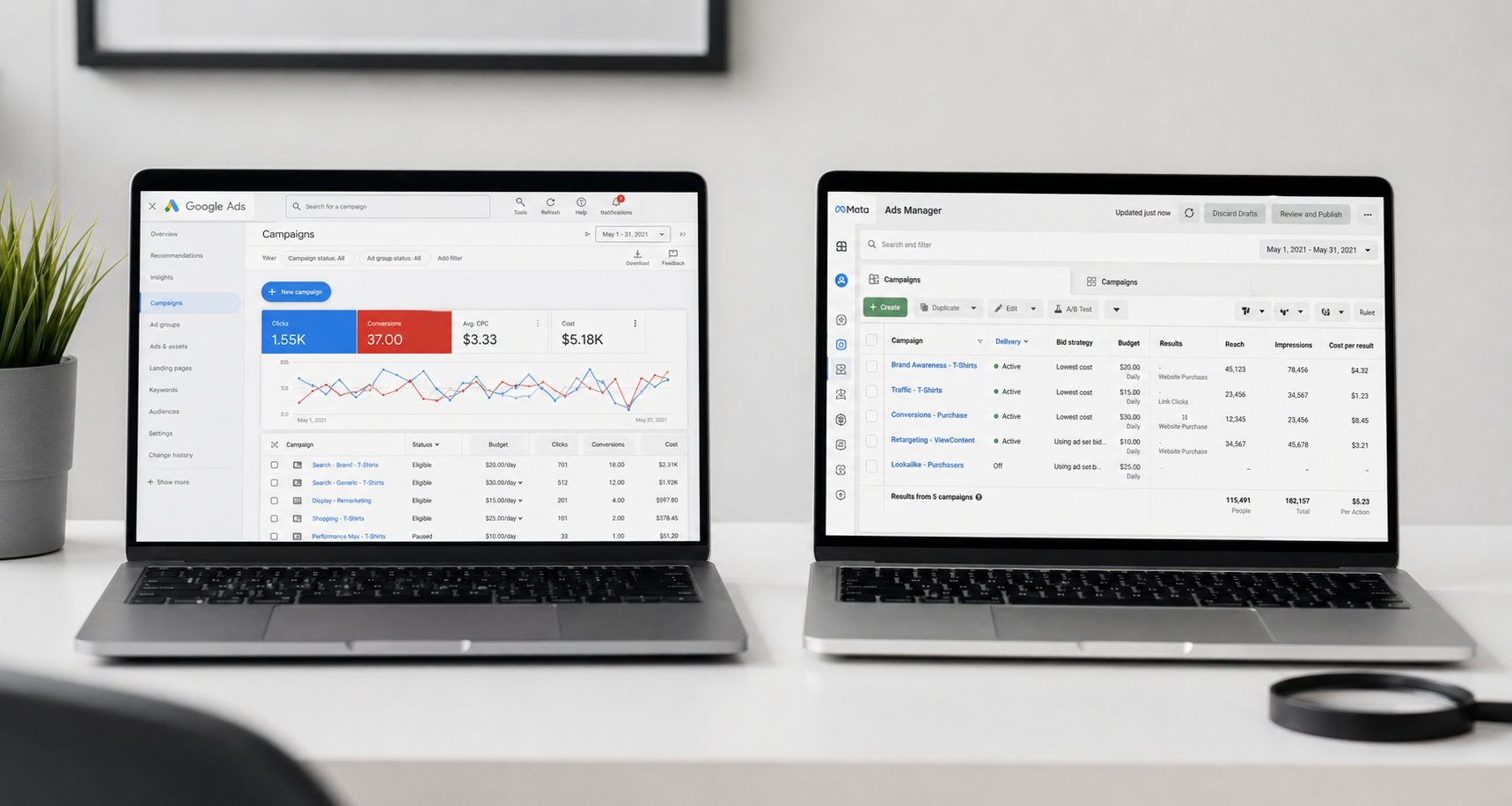
Google Ads (formerly Google AdWords) is Google’s advertising platform. It lets businesses place ads across Google Search, YouTube, Gmail, Google Maps, and millions of partner websites through the Google Display Network.
Meta Ads is the advertising system owned by Meta Platforms Inc. — the parent company of Facebook, Instagram, WhatsApp, and Messenger. When you run a Meta ad, you can show it across all of these platforms from a single dashboard.
Together, these two platforms account for more than 50% of all global digital ad spending. That’s not a coincidence — it’s because they work.
Google Ads: Intent-Based Advertising
Google Ads is built around search intent. When someone types “buy running shoes near me” into Google, they are actively looking for something. Google Ads lets businesses appear right at that moment — in front of someone who already wants what they’re selling.
This is what makes Google Ads incredibly powerful for driving conversions. The user has signaled their intent. Your ad shows up. They click. They buy.
Meta Ads: Audience-Based Advertising
Meta Ads work differently. Instead of targeting people based on what they’re searching for, Meta targets based on who they are — their age, location, interests, behaviors, job titles, relationship status, and much more.
Meta has access to one of the largest behavioral datasets in the world, built from billions of daily interactions across Facebook and Instagram. This gives advertisers an extraordinary ability to reach very specific people — even before those people know they want something.
How Google and Meta Ads Actually Work
Both platforms use an auction-based system, meaning you don’t just pay a flat fee to run ads. You bid for placement, and several factors determine whether your ad shows — and what you pay.
The Google Ads Auction System
Every time someone performs a Google search, an instant auction takes place in the background. Google evaluates:
- Your bid (how much you’re willing to pay per click)
- Your Quality Score (a rating based on ad relevance, expected click-through rate, and landing page experience)
- Your Ad Rank (a combination of bid × Quality Score)
A higher Quality Score means you can sometimes outrank a competitor who bids more than you — simply because your ad is more relevant and useful. This rewards good advertising, not just deep pockets.
Targeting on Google and Meta Ads
On Google, targeting is primarily keyword-based. You choose the search terms you want your ads to appear for. You can also target by location, device, time of day, and audience demographics.
On Meta, targeting is audience-based. You build a profile of the person you want to reach. You can target custom audiences (people who’ve visited your website), lookalike audiences (people similar to your existing customers), or interest-based audiences built directly in Meta’s Ads Manager.

Why Google and Meta Ads Are the Top Ad Platforms
There are dozens of digital advertising platforms available today — LinkedIn Ads, Twitter/X Ads, Pinterest Ads, Snapchat Ads, TikTok Ads. So why do Google and Meta Ads consistently come out on top?
The answer comes down to three things: reach, data, and results.
Reach: Google processes over 8.5 billion searches every single day. Meta has over 3.2 billion daily active users across its family of apps. No other platforms come close.
Data: Both Google and Meta have spent decades collecting behavioral data on their users. This data allows for targeting precision that other platforms simply cannot match.
Results: Businesses across every industry and every size — from local bakeries to Fortune 500 companies — consistently report positive ROI from Google and Meta Ads when campaigns are set up and managed properly.
Google and Meta Ads: Key Differences You Should Know
While both platforms serve paid ads, they work in fundamentally different ways. Understanding these differences is essential for choosing the right strategy.
| Google Ads | Meta Ads | |
|---|---|---|
| Targeting approach | Keyword/Intent-based | Audience/Behavior-based |
| Best for | High-intent buyers | Brand awareness & discovery |
| Ad formats | Search, Display, Video, Shopping | Image, Video, Carousel, Stories |
| Typical cost model | CPC (Cost Per Click) | CPM or CPC |
| Platform reach | Google Search, YouTube, Gmail, GDN | Facebook, Instagram, Messenger, WhatsApp |
The short version: Google Ads captures demand (people looking for you), while Meta Ads creates demand (people discovering you).
The smartest advertisers use both.
6 Smart Reasons to Run Google and Meta Ads
Budget Flexibility on Both Platforms
You don’t need a massive budget to get started. Both Google and Meta Ads allow you to set daily or lifetime budgets as low as a few dollars a day. You can start small, test what works, and scale up confidently.
1. Unmatched Audience Reach Between Google and Meta, you have access to virtually every internet user on the planet. Google reaches people through search and browse intent. Meta reaches them through social discovery. Together, there’s almost no demographic you can’t reach.
2. Precise Targeting Capabilities Both platforms offer targeting options that no traditional advertising channel can match. You can show your ad to a 28-year-old woman in Mumbai who likes yoga, recently visited your competitor’s website, and earns above a certain income level. That level of precision wasn’t possible 15 years ago.
3. Measurable, Trackable Results Unlike a billboard or a TV commercial, every rupee spent on Google and Meta Ads is fully trackable. You know exactly how many people saw your ad, clicked it, and converted. This makes it easy to calculate ROI and optimize over time.
4. Flexible Ad Formats for Every Goal Whether you want to drive website traffic, generate leads, get app downloads, promote a video, or run a product catalogue — Google and Meta Ads have ad formats built for your specific goal.
5. Retargeting That Converts Both platforms allow you to retarget people who’ve already interacted with your brand. Someone visited your pricing page but didn’t sign up? You can show them a reminder ad on Facebook the next day. Retargeting is one of the highest-converting strategies in digital marketing.
6. Scalable for Any Business Size Whether you’re a solo freelancer with ₹500/day or a large enterprise with a ₹50 lakh monthly budget, both platforms scale with you. The same tools and targeting options are available regardless of your spend level.
Common Mistakes to Avoid With Google and Meta Ads
Even experienced marketers make avoidable mistakes. Here are the most common ones:
Not defining a clear objective. Both platforms ask you to choose a campaign objective before you launch. Picking the wrong one (e.g., choosing “Brand Awareness” when you want conversions) leads to poor results regardless of budget.
Skipping the landing page. Getting clicks is only half the battle. If your landing page is slow, confusing, or irrelevant to the ad, you’ll waste your budget. Your ad and landing page need to tell a consistent story.
Targeting too broadly or too narrowly. Broad targeting wastes budget on irrelevant audiences. Hyper-narrow targeting limits reach so severely that the algorithm can’t optimise. Start moderately specific and adjust based on data.
Not testing creatives. The best advertisers run A/B tests on headlines, images, copy, and calls to action. What you think will work often isn’t what actually performs. Let the data guide you.
Ignoring analytics. Both platforms give you rich performance data. If you’re not reviewing it regularly and making changes, you’re leaving money on the table.
Final Thoughts
Google and Meta Ads are not a magic button. They require strategy, testing, and patience. But when used correctly, they are two of the most powerful tools available to any business that wants to grow online.
Google helps you reach people the moment they’re ready to buy. Meta helps you build awareness, nurture interest, and retarget warm leads. Together, they cover the entire customer journey — from first impression to final sale.
Whether you’re just starting out or looking to scale an existing ad strategy, understanding these platforms is no longer optional. It’s essential.
Start small. Learn the platforms. Test everything. And don’t stop optimising.
Frequently Asked Questions
FAQ: Are Google and Meta Ads worth it for small businesses?
Yes — in most cases, absolutely. Both platforms are specifically designed to work for businesses of all sizes. The key is starting with a clear goal, a defined audience, and a realistic budget. Even ₹300–500 per day can generate meaningful results when campaigns are set up correctly.
FAQ: What is the minimum budget for Google and Meta Ads?
There is no hard minimum. Google Ads technically allows campaigns with any daily budget, though most experts recommend starting with at least ₹500–1,000/day to give the algorithm enough data to optimise. Meta Ads similarly allows low-budget starts, with most ad sets performing better above ₹200–300/day per ad set.
FAQ: Can I run Google and Meta Ads at the same time? Yes, and many businesses do. Running both simultaneously gives you full-funnel coverage — Google captures people who are actively searching, while Meta builds awareness and retargets warm audiences. The two platforms complement each other well.
FAQ: Do I need an agency to run Google and Meta Ads? Not necessarily. Both platforms have self-serve interfaces that beginners can learn. That said, the learning curve is real — common mistakes can waste budget quickly. For businesses without time to learn, working with a certified ads professional can pay for itself quickly.
FAQ: Which platform gives better ROI — Google or Meta? It depends entirely on your business type, product, audience, and funnel stage. E-commerce businesses often see strong returns from Meta’s visual formats. B2B companies and service providers often do better on Google. Many businesses find the highest ROI by using both together.