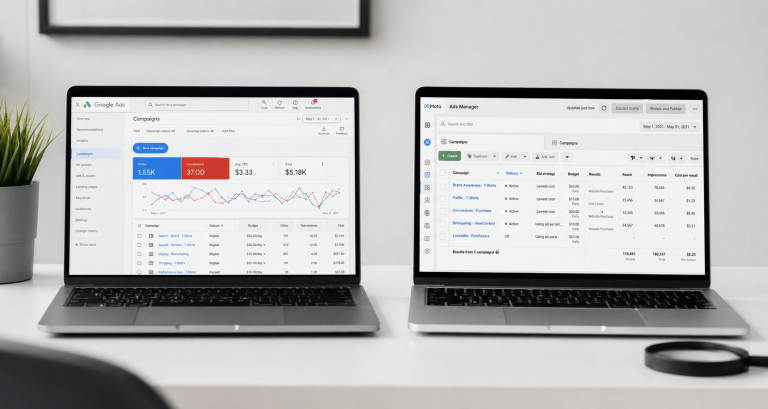


Introduction
I remember the first time I set up a Google Ads campaign. I stared at the screen and had no idea whether to pick search ads or display ads. So I picked both, spent my budget in three days, and had nothing to show for it.
If you have ever felt that confusion, this post is for you. The debate around search ads vs display ads is one of the most common questions in digital marketing. Both are powerful. But they work very differently. In this guide, you will learn exactly how each ad type works, when to use them, and how to make the right choice for your business or budget.

Table of Contents
What Are Search Ads vs Display Ads, Really?
Before comparing them, you need to understand what each one actually does. They look different, feel different, and serve different purposes.
How Search Ads Work
Search ads appear at the top or bottom of Google search results. When someone types a query like “best running shoes under 3000,” your ad can show up right there. These ads are text-based. They are triggered by specific keywords that you bid on. The user is already looking for something. Your ad just shows up at the right moment.
Search ads work on a pay-per-click (PPC) model. You only pay when someone clicks your ad. This makes them very budget-friendly for businesses that want direct responses.
How Display Ads Work
Display ads are visual ads. They include images, banners, and sometimes video. They appear on websites, apps, and YouTube that are part of the Google Display Network. This network reaches over 90% of internet users globally, according to Google’s own data.
Unlike search ads, display ads do not wait for someone to search. They reach people while they are reading an article, watching a video, or browsing a news site. The goal is usually brand awareness rather than immediate clicks.

How Search Ads vs Display Ads Target Your Audience
This is where things get really interesting. The targeting approach is completely different for each ad type.
Intent-Based Targeting in Search Ads vs Display Ads
Search ads rely on search intent. The user is actively looking for something. This is called high-intent traffic. Someone searching “buy leather wallet online” is very close to making a purchase. Your ad meets them exactly at that moment. That is why search ads tend to have higher conversion rates compared to display ads.
Intent targeting is the biggest strength of search advertising. It is precise, timely, and action-driven.
Awareness Targeting with Display Ads
Display ads use a different approach. They target based on audience interest, demographics, browsing behaviour, and remarketing lists. You can reach people who visited your website before. You can also target new users based on their online habits.
Display ads are brilliant for remarketing campaigns. If someone visited your product page but did not buy, a display ad can remind them later while they scroll through another website. This gentle nudge often brings them back.
When to Use Search Ads vs Display Ads
Knowing when to use each type is the real skill. Here is a clear breakdown.
Best Situations for Search Ads
Use search ads when:
- You want immediate sales or leads
- Your product or service solves a specific problem people search for
- You have a limited budget and want maximum intent-driven results
- You are running promotions with a deadline
- Your product has clear buying keywords like “buy,” “hire,” “near me,” or “price”
Search ads are ideal for local service businesses, e-commerce stores, and anyone who needs fast results.
Best Situations for Display Ads
Use display ads when:
- You want to build brand awareness over time
- You are launching a new product most people do not know about yet
- You want to retarget visitors who left your website
- You have a strong visual brand with great creatives
- You want to reach a broad audience at a lower cost per thousand impressions (CPM)
Display ads are ideal for new businesses, app launches, lifestyle brands, and long sales-cycle products.

Cost and Budget: Search Ads vs Display Ads Compared
Let us look at the numbers. Cost is often the deciding factor for small businesses.
Understanding CPC Differences
Search ads tend to have a higher cost-per-click (CPC). In competitive industries like insurance or legal services, CPC can go above Rs. 500 per click. However, the conversion rate is also much higher because of intent targeting.
Display ads have a lower CPC, often below Rs. 5 to Rs. 20 per click in most Indian markets. But the conversion rate is also lower because users are not actively searching for what you offer.
Here is a comparison table to make things clearer:
| Feature | Search Ads | Display Ads |
|---|---|---|
| Ad Format | Text-based | Image/Banner/Video |
| Placement | Google Search Results | Websites, Apps, YouTube |
| Targeting | Keyword intent | Interests, Demographics, Behaviour |
| Average CPC | Higher (Rs. 50 to 500+) | Lower (Rs. 5 to 50) |
| Conversion Rate | High (2%-10%+) | Low (0.5%-2%) |
| Best For | Leads, Sales, Immediate ROI | Brand Awareness, Retargeting |
| Reach | Smaller, targeted | Massive, broad |
| Visual Appeal | Text only | Highly visual |
| Remarketing | Limited | Excellent |
| Learning Curve | Medium | Medium to High |
ROAS and Conversion Comparison
Return on Ad Spend (ROAS) tends to be higher with search ads in the short term. But display ads can deliver strong ROAS over time through brand recall and retargeting. According to WordStream’s Google Ads benchmarks, the average conversion rate for search ads across industries is around 3.75%, while display ads average around 0.77%.
Both numbers matter. It just depends on what goal you are chasing right now.
Which Gets Better Results?
Honestly? It depends on your goal.
- If you want fast results and sales, search ads win.
- If you want brand visibility and reach, display ads win.
- If you want both, run them together at different stages of your funnel.
Many smart marketers use search ads for bottom-of-funnel (ready to buy) audiences and display ads for top-of-funnel (not yet aware) audiences. This combination is often called a full-funnel strategy and it tends to work very well.
The truth is, the best campaigns use both types strategically. Not one or the other.
Pros and Cons
Pros of Both Ad Types
Search Ads:
- Reaches high-intent buyers at the right moment
- Only pay when someone clicks
- Highly measurable and trackable
- Works well even with a small budget
- Easy to control with exact match and negative keywords
Display Ads:
- Massive reach across millions of websites
- Great for visual storytelling and brand building
- Powerful for remarketing campaigns
- Lower cost per impression
- Builds long-term brand recognition
Cons of Both Ad Types
Search Ads:
- Higher CPC in competitive niches
- Limited creative space (text only)
- Can drain budget fast without proper negative keywords
- Requires constant keyword research and optimisation
Display Ads:
- Much lower conversion rates
- Can feel intrusive to users
- Requires strong visual creatives to perform
- Ad fatigue is common if frequency is not managed
- Lower purchase intent from the audience

Practical Guide: How to Get Started
Ready to run your first campaign? Here are the steps that actually work:
- Define your goal first. Do you want sales, leads, or brand awareness? Your goal decides your ad type.
- Start with search ads if you are new to paid advertising. They are easier to control and the intent is clear.
- Set a daily budget cap. Start with Rs. 200 to Rs. 500 per day and test before scaling.
- Do keyword research using Google Keyword Planner. Focus on keywords with clear buying intent.
- Add negative keywords from day one. This stops your ads from showing to irrelevant searchers.
- Launch display retargeting after you get some website traffic. This is the most cost-effective display strategy.
- Track everything. Link Google Ads to Google Analytics and set up conversion tracking before you spend a single rupee.
- Review performance weekly, not daily. Give campaigns at least 7 to 14 days to gather data.
For more tips on growing your business with smart digital marketing, check out growwithmridul.in for beginner-friendly guides and practical advice.
Wrapping It Up
Lorem ipsum dolor sit amet, consectetur adipiscing elit. Ut elit tellus, luct
Here is a quick recap of what you learned:
- Search ads target people actively searching for your product. They have higher intent and better short-term conversions.
- Display ads build awareness and are powerful for retargeting and visual branding.
- Cost and conversion rates are very different between the two.
- The right choice depends on your goal, budget, and stage of business growth.
- A full-funnel strategy using both ad types together often delivers the best results.
My honest advice? Start with search ads, get your conversions rolling, then add display retargeting once you have traffic. Build it step by step.
You do not need a massive budget. You need a smart strategy. And now you have one.
us nec ullamcorper mattis, pulvinar dapibus leo.
Frequently Asked Questions
Which is better for beginners: search ads vs display ads?
Search ads are better for beginners. They are more intent-driven, easier to set up, and easier to control. You only pay when someone clicks, which makes budget management simpler. Display ads need stronger creatives and audience knowledge, which can be tricky when you are just starting out.
Can I run search ads vs display ads at the same time?
Yes, absolutely. Running both together is called a full-funnel strategy. Use search ads to capture people who are ready to buy and display ads to retarget people who visited your site but did not convert. Together, they cover different stages of the buyer journey.
Why are search ads more expensive than display ads?
Search ads are more expensive because they target high-intent users. Someone who searches for a product is much more likely to buy than someone who sees a banner while reading an article. Advertisers pay a premium for that buying intent. Display ads cost less per click but the traffic is generally less ready to purchase.
How much budget do I need to start search ads vs display ads in India?
For search ads in India, you can start with as little as Rs. 200 to Rs. 500 per day. For display ads, you can start with even less because CPM is cheaper. The key is to start small, test your campaigns for at least 2 weeks, and then scale what is working.
What is the biggest mistake people make with search ads vs display ads?
The biggest mistake is mixing up goals. People run display ads expecting immediate sales or run search ads for pure brand awareness. Both can work, but only when matched to the right goal. Always decide your objective first, then pick the ad type that fits. That one shift alone can double your results.